Kazar
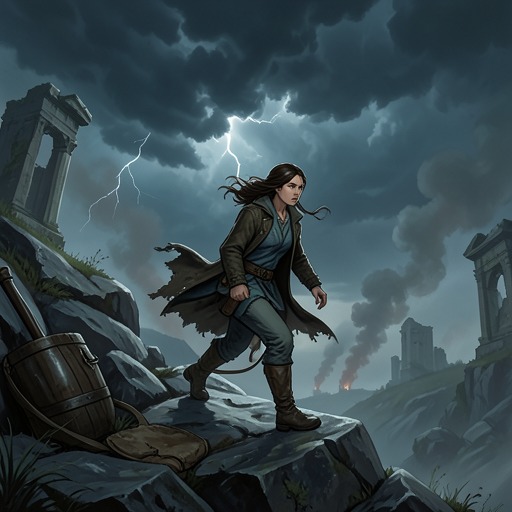
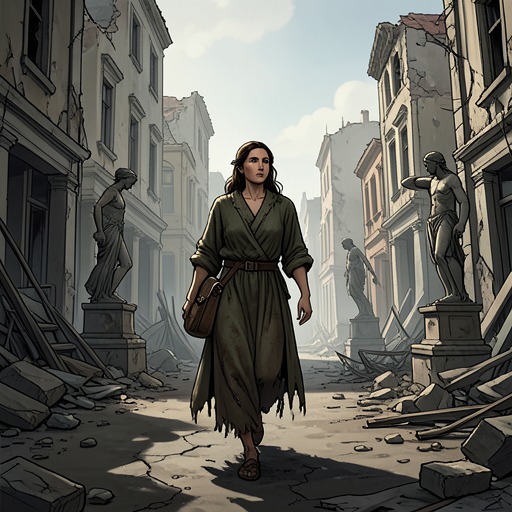
The Calamitous BobKazar is a small city in the kingdom of Enoria, positioned at the living edge of the Deadlands. Its importance lies less in military grandeur than in its origin and ecological position: it began as a temporary settlement around a millennial tree that purified the surrounding air and drove back black mana, and it later became the place where Viviane Saint-Lys crossed from prolonged survival into the possibility of residence, work, and community.
Setting and Historical Position
Kazar lies toward the eastern end of Param, while the Deadlands occupy the continent’s western region. Param itself is a large circular landmass connected to its only neighboring continent by a narrow isthmus. The geography gives Kazar a wider political context: Baran lies in the far east, while Enoria is the local kingdom to which Kazar belongs. Enoria had once been a major power, but it split into two parts fifteen years earlier after a failed coup, a purge of the nobility, and a two-year civil war that ended with the king’s death and the retreat of both factions.
The city’s position also places it within the long shadow of the Old Empire. The western part of Param bears the scar of the greatest magical catastrophe on record: a vast valley enclosed by snow-capped mountains, with the Old Empire’s former seat of power at its center. Its planned cities, estates, temples, churches, and squares are now dead, while mindless undead move across its remains. At the top of the enormous pyramid that once dominated that imperial landscape, an internal detonation left a crater with the scale of an asteroid impact or tactical nuclear strike. Kazar therefore belongs to a world in which political borders and living settlements have been built around the ruins and consequences of a vanished imperial center.
The Millennial Tree and the Deadlands Boundary
Kazar originated as a temporary settlement around the millennial tree at its center. The ancient being made the surrounding air purer and chased away black mana, giving the first inhabitants a pocket of livable territory beside the Deadlands. Although the Deadlands later retreated somewhat and border stones prevented most of the black mana from passing into the city, Kazar preserved the memory of the tree’s protection: the benefactor remains on the city’s official coat of arms.
The tree’s significance is reinforced by the broader mythology of life resisting catastrophe. Cassia the Unbroken fought for the Empire and the other nations of the continent and was universally loved; when she died after a long and fulfilling life, the ground opened and a spring emerged. The waters of the Cassian Spring still carry Neriad’s blessing. Kazar is not identified with that spring, but both places embody the same pattern: living or sacred forces create survivable islands within landscapes damaged by magic, war, and death.
The Deadlands are not simply an exhausted wasteland waiting to disappear. Their black mana has reached an equilibrium because the enormous population of undead monsters generates a black field of its own. According to Cernit, it would require several large-scale expeditions to kill enough creatures to weaken that field, and no kingdom considers such an investment worthwhile for land that would take decades to recover. Kazar’s border stones and central tree thus represent maintenance and adaptation rather than a final victory over the Deadlands.
Population, Economy, and Urban Life
Kazar’s population is approximately two thousand. More than half live along a narrow band of arable land between the forest and the desert, a spatial arrangement that makes the city’s food supply visibly dependent on the livable strip created between opposing environments. Farms and cottages surround the approach to the walls, while the region nearer the Deadlands is in poorer condition.
The city walls are twice Viviane Saint-Lys’s height and covered in white plaster. Five guards control the gate, carrying spears, shields, and truncheons, with one guard also equipped with a bow. Their equipment and clothing mark Kazar as an organized settlement rather than an isolated frontier camp: they wear undyed leather jerkins over off-white shirts, each jerkin bearing an inscribed shield with a tree, and steel helmets resembling conquistador morions with neck guards. The guards’ appearance is broadly related to that of the Baranese knights, but Viviane Saint-Lys visibly stands apart from them, making her foreignness immediately apparent at the entrance.
Kazar also has an active textile economy. In the southern part of the city, houses are in better condition and residents conduct ordinary daily business. Weavers are numerous, with thick rolls of cloth stacked in compact crates, apparently for export. Viviane Saint-Lys buys flour, oil, meat, green beans, roots, and spices in the market, demonstrating that the city can support both production and trade despite its proximity to the Deadlands. A clothing shop produces a complete wardrobe for her over three days, while a preternaturally fast weaving station and communal singing give the shop an atmosphere of skilled domestic industry.
Viviane Saint-Lys’s Arrival and Settlement
Viviane Saint-Lys reaches Kazar after traveling out of the Deadlands with Cernit’s group. As the journey progresses, black mana density falls even through the inscribed leather covering her body. Revenants become rarer, and some are even seen walking back toward the Deadlands. The forest on the horizon is especially important to her because it is the first time in her life that she has seen so much living green. Kazar appears not as an abstract destination but as a visible threshold: behind it lies the gray and darkened wasteland, while ahead are fields, trees, wet earth, sap, animals, and human labor.
Cernit leaves her before continuing east toward a Church base. He explains that she can enter the city by presenting the mercenary license he prepared, find employment as a mercenary, or move on using the money she already possesses. The license converts her from a suspicious outsider emerging from the Deadlands into someone who can at least be processed through the city’s ordinary economic and legal channels.
After passing through the gates, Viviane Saint-Lys encounters fields, cottages, guards, and the visual signs of a functioning rural economy. The final approach is physically difficult: although the route is safer and friendlier than the Deadlands, she must stop roughly every hundred meters to breathe. The wind carries the scent of sap and wet earth, animals make distant barnyard sounds, and a farmer pauses to look at her before returning to his work. Two men carrying crates follow her at a distance and stop whenever she stops, adding a small note of uncertainty to her entry into civilization.
Marruk later guides her through the city’s practical arrangements. They purchase food and supplies, and a sled carries them through the southern gate to a cubic walled mansion with four bedrooms and a cellar. Viviane Saint-Lys lets Marruk take the room facing the rising sun and chooses the most comfortable room for herself. The mansion becomes a decisive psychological marker: until then, she had been transient, a vagrant moving from a tower or an inn toward some uncertain solution. In Kazar, she accepts that her immediate reality includes no internet, former friends, or family, but does include monsters and Magic. The house gives that acceptance a physical form.
People, Borders, and Narrative Significance
Kazar is a meeting point for cultures and political histories that Viviane Saint-Lys can only gradually decode. Cernit’s tattered map and Solfis’s interpretation allow her to learn that she is at the western end of Param, that the Baranese knights come from the east, and that the continent contains numerous kingdoms, nearby large countries, and many smaller political units. The map places the Harrakan heartlands, marked with a small skull, far from Baran and separates them by several other countries.
The city also exposes the tensions surrounding non-human peoples. Marruk is a female Kark who recently left her tribe, or what remains of it. The Kark are experiencing severe hardships, and the local mercenaries have subjected Marruk to abuse. The Northern Free cities have formed an alliance of interest called the Pure League, but the conflict is not simply a war between all humanity and the Kark. Kazar’s local knowledge instead presents Marruk as a person whose promises can be trusted and whose treatment reflects broader political and social pressures.
The city’s deepest narrative function is its contrast with the Deadlands. Earlier, Viviane Saint-Lys reasons that the abandoned imperial zone cannot sustain renewable food and probably never receives rain; buildings exist in abundance, yet survival remains impossible because the environment is fundamentally dead. Kazar reverses those conditions without erasing the danger beyond its borders. It has farms, markets, textile production, guards, walls, domestic interiors, and a forest where Arthur can run and climb. When Viviane Saint-Lys reaches the edge of the millennial tree, Arthur explores the grass and moves from trunk to trunk, while Kazar stands in the distance and the hill changes from vibrant green to gray toward the top. The image preserves both sides of the threshold: life has returned, but the Deadlands remain close enough to color the horizon.
Kazar therefore marks more than a location on Viviane Saint-Lys’s route. It is the first place where survival acquires continuity. Its tree, border stones, farms, guards, markets, and rented mansion show a community adapting to a permanent magical catastrophe rather than defeating it. For Viviane Saint-Lys, that modest endurance makes Kazar a provisional home and the first concrete sign that her life in Niyl may become something other than an endless flight from death.